VA Zombie Comic Explained: Veterans, Insomnia, and Ambien at Hines VA
- By PowerPoint Ranger Editorial Team
- First published
- Last updated
- In Army life, Uncategorized
VA Zombie is a December 2012 PowerPoint Ranger comic showing a green-skinned Operation Iraqi Freedom veteran groaning 'Sleeeeeep' outside the Edward Hines, Jr. VA Hospital next to a giant bottle of 5 mg Ambien (zolpidem tartrate). The strip uses dark humor to highlight post-deployment insomnia and sleep medication.

Part of our guide: Uncategorized
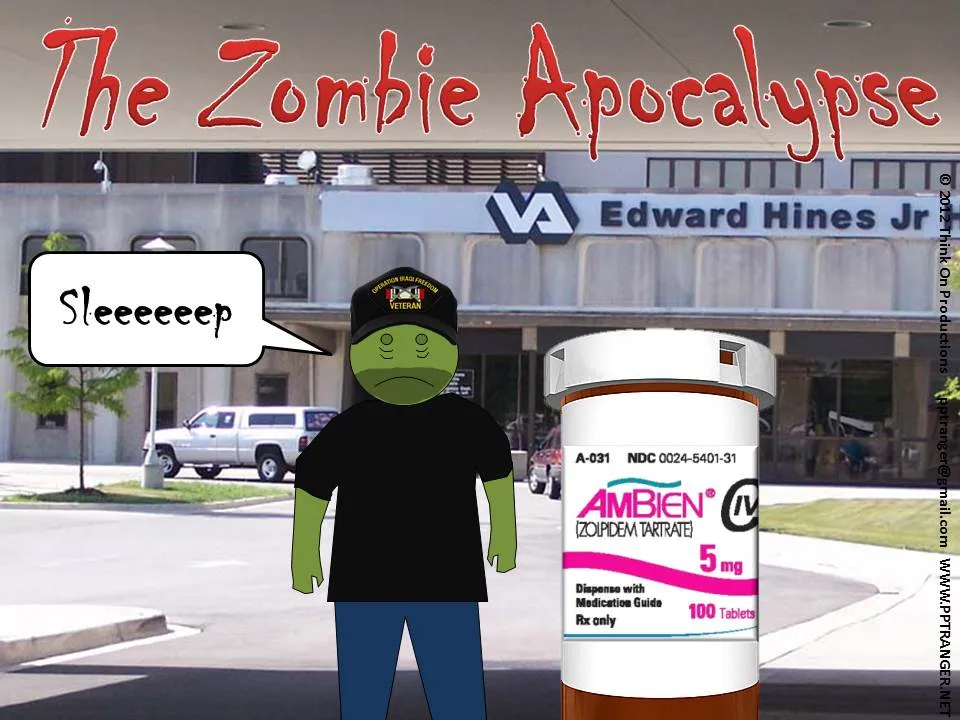
Published on December 5, 2012 in the PowerPoint Ranger comic archive, VA Zombie trades the typical brains-hungry monster trope for something far more familiar to Iraq and Afghanistan veterans: chronic exhaustion. Standing in front of a building with the Edward Hines Jr VA sign, a green-skinned veteran wearing an “Operation Iraqi Freedom Veteran” cap groans “Sleeeeeep” beside a towering prescription bottle labeled Ambien (zolpidem tartrate) 5 mg, 100 Tablets. The strip’s headline reads “The Zombie Apocalypse.”
Like The Bottle and Mandatory Classes, VA Zombie uses dark, self-deprecating soldier humor to point at a real post-deployment issue. Behind the punchline is a well-documented reality: sleep disorders are one of the most widespread health challenges facing Post-9/11 veterans, and the guidance on how to treat insomnia has been updated since 2012.
Why is the comic set at Edward Hines, Jr. VA Hospital?
PowerPoint Ranger sometimes pairs cartoon figures with real photographs, as NCO Academy does with a Fort Leonard Wood building. Here, the backdrop is a photo of Edward Hines, Jr. VA Hospital, which describes itself as “12 miles west of downtown Chicago.”
The About Us page says “We are the largest VA in the state of Illinois,” serving “more than 56,000 Veterans,” and lists six community-based outpatient clinics in Aurora, Hoffman Estates, Joliet, Bourbonnais, Peru, and Oak Lawn. A Hines VA story about its Sleep Clinic describes a “five-bedroom sleep lab” and at-home sleep tests with a kit mailed to the veteran.
How common is insomnia among Iraq and Afghanistan veterans?
The comic’s zombie metaphor—a veteran who can’t rest and shuffles toward the hospital groaning for sleep—is a joke, but the numbers behind it are real. According to a 2020 VA study cited in a Hines VA story featuring Sleep Clinic supervisor Jason Torres:
- 57 percent of Post-9/11 Veterans reported insomnia-like symptoms, compared to 30 percent of non-veterans.
- Among veterans diagnosed with post-traumatic stress disorder (PTSD), that figure climbs to over 90 percent reporting sleep issues.
- Over 400,000 veterans receive VA disability compensation for service-connected sleep apnea, making it the leading respiratory disability affecting veterans.
As the VA Veterans Health Library explains, troops often stay alert for long stretches during deployment, so “your body has to re-learn how to wind down and relax at night.” That readjustment gap is also the subject of The Bottle.
Why does the comic feature a 100-tablet bottle of Ambien 5 mg?
Ambien (zolpidem tartrate) is a well-known prescription sleep medication. In the comic, the oversized label reads “AMBIEN (ZOLPIDEM TARTRATE) 5 mg, 100 Tablets, Rx only,” exaggerating how big the problem of sleeplessness feels. The strip is not making a claim about actual prescribing rates.
Ambien is indicated for the short-term treatment of insomnia characterized by trouble falling asleep. According to FDA prescribing information for Ambien:
| Safety / Dosing Factor | FDA Prescribing Guidance |
|---|---|
| Recommended initial dose | 5 mg once nightly for women; 5 mg or 10 mg once nightly for men (use lowest effective dose) |
| Timing before waking | Take immediately before bedtime with at least 7–8 hours remaining before planned awakening |
| Intended duration | Short-term treatment; if insomnia continues after 7 to 10 days, the label advises evaluating for an underlying psychiatric or medical condition |
| Boxed warning | Complex sleep behaviors (sleep-walking, sleep-driving, acting while not fully awake), which can cause serious injury or death |
| Alcohol / CNS depressants | Combining with alcohol or other CNS depressants increases the risk of excessive drowsiness and impaired coordination and driving |
The label also says higher doses can cause next-day impairment, including unsafe driving. None of this is medical advice; talk to a clinician about any sleep medication.
How does the VA treat veteran insomnia today?
While the 2012 comic jokes about a giant bottle of Ambien, current guidance leans toward behavioral treatment. The 2025 VA/DoD clinical practice guideline, summarized in a Defense Health Agency provider’s guide, recommends offering Cognitive Behavioral Therapy for Insomnia (CBT-I) and suggests CBT-I over pharmacotherapy as first-line treatment for chronic insomnia disorder.
The Hines VA story describes the following at its Sleep Clinic:
- Sleep testing: Veterans can spend a night in a five-bedroom sleep lab where a technologist monitors them, or take a sleep test at home with a kit mailed to them.
- CPAP care: Patients diagnosed with sleep apnea can get a CPAP machine through the CPAP clinic, which also teaches them how to use it.
- Habit changes: The article notes that many sleep problems improve with habit changes, though some need medical care.
- Behavioral therapy: The VA/DoD guideline summary above describes CBT-I as a multi-session behavioral treatment.
Note: This article explains the humor and historical context of a 2012 comic strip and is not medical advice. Veterans experiencing chronic insomnia, nightmares, or medication side effects should speak directly with a VA primary care provider or sleep clinician.
Why do so many Post-9/11 veterans struggle with sleep after service?
Poor sleep in the veteran community rarely has a single cause, and this page can only point to what its sources say. The VA Veterans Health Library notes that troops often stay alert for long stretches during deployment, and that insomnia is common after coming home.
The Hines VA story points to several factors:
- Readjustment: Troops often stay alert for long stretches during deployment, so “your body has to re-learn how to wind down and relax at night,” according to the VA Veterans Health Library.
- PTSD and nightmares: As the 2020 VA study cited by Hines VA shows, more than 90 percent of veterans diagnosed with PTSD experience sleep disturbances.
- Sleep apnea: Over 400,000 veterans receive VA disability compensation for service-connected sleep apnea, which the Hines VA story calls the greatest respiratory disability affecting Veterans. It also says patients diagnosed with sleep apnea can get a CPAP machine through the Hines CPAP clinic.
How does Cognitive Behavioral Therapy for Insomnia (CBT-I) work?
The VA/DoD guideline summary recommends Cognitive Behavioral Therapy for Insomnia (CBT-I), which the guide describes as a multi-session, multi-component behavioral treatment. In the Hines VA story, Sleep Clinic supervisor Jason Torres passes along American Academy of Sleep Medicine recommendations for sleep habits:
- Use the bedroom for sleeping: Torres said the AASM recommends that the bedroom be used for sleeping, so screens and other entertainment stay out.
- Keep a fixed schedule: Going to bed and getting up at the same time every day, including the weekend.
- Mind meals and exercise: Avoid drinking liquids and heavy meals two to three hours before bed, and aim for 30 minutes of exercise daily but not four to six hours before bed.
What services does the Edward Hines, Jr. VA Hospital Sleep Clinic provide?
For veterans in the Chicago area—the exact community pictured in VA Zombie—the real Edward Hines, Jr. VA Hospital describes a Sleep Clinic that offers overnight monitoring in a five-bedroom sleep lab or a home sleep test with a mailed kit, plus a CPAP clinic for patients diagnosed with sleep apnea. (The clinic details come from the Hines VA story linked above.)
How does VA Zombie fit into PowerPoint Ranger’s 2012 zombie series?
The strip’s headline reads “The Zombie Apocalypse,” and the title of this page calls it VA Zombie. It uses the undead trope to make a point about post-deployment life: after a deployment, getting a normal night’s sleep can feel harder than surviving a zombie movie. Paired with Mandatory Classes and The Bottle, it is a snapshot of OIF/OEF veteran humor. The same promise to take care of each other after the mission ends is the subject of the military creed video, which covers what the U.S. does for service members after a war.
How can veterans access sleep care through the VA today?
Veterans who recognize themselves in VA Zombie—waking up exhausted, relying on short-term sleep aids, or struggling with deployment-era insomnia—have straightforward paths into VA care:
- Talk to a VA clinician: Ask about CBT-I and about a sleep evaluation; the VA/DoD guideline summary recommends offering CBT-I for chronic insomnia.
- Ask about sleep testing: At Hines VA, the Sleep Clinic offers an overnight sleep lab or a mailed home sleep-test kit.
- Review medications safely: Never stop or adjust prescription sleep medications like zolpidem without speaking to your prescribing clinician first.
What does the comic leave out?
A joke strip cannot carry nuance, and this one does not try. It shows one veteran, one hospital sign, and one oversized pill bottle. It does not say why the veteran cannot sleep, whether he has been diagnosed with anything, or what treatment he has been offered. The sources on this page fill in some of that context: the VA story reports high rates of insomnia-like symptoms among Post-9/11 Veterans, the VA Veterans Health Library calls insomnia a common response to major life changes, and the 2025 VA/DoD guideline summary points toward CBT-I as the first-line approach for chronic insomnia. Readers who see themselves in the zombie should treat the comic as a laugh and the sources as the starting point for a real conversation with a clinician.
Why did the 2012 comic resonate so strongly with OIF and OEF veterans?
The strip’s humor is aimed at veterans who recognize the zombie shuffle after a bad night. The statistics above show that sleep trouble is common among Post-9/11 veterans, and the comic turns that into a shared laugh; it is not a substitute for care, and anyone struggling with sleep should talk to a clinician.
Quick answers
What VA hospital is shown in the VA Zombie comic?
The building in the background is the Edward Hines, Jr. VA Hospital in Hines, Illinois, located about 12 miles west of downtown Chicago. It is the largest VA hospital in Illinois, serving more than 56,000 Veterans, according to its own About Us page. A separate Hines VA story describes its Sleep Clinic.
Why does the VA Zombie comic show a giant bottle of Ambien 5 mg?
The comic exaggerates a prescription label for Ambien (zolpidem tartrate) 5 mg, 100 tablets. The joke is that a sleep-deprived veteran shuffles toward the VA like a zombie groaning for sleep, with a giant pill bottle beside him. The strip does not claim any statistic about prescribing.
How common is insomnia among Post-9/11 veterans?
According to a 2020 VA study cited by Edward Hines, Jr. VA Hospital, 57 percent of Post-9/11 Veterans reported insomnia-like symptoms compared to 30 percent of non-Veterans. Among Veterans diagnosed with post-traumatic stress disorder (PTSD), more than 90 percent report sleep difficulties.
What are the FDA safety warnings on zolpidem (Ambien)?
FDA prescribing information for zolpidem tartrate includes a boxed warning for complex sleep behaviors such as sleep-walking, sleep-driving, and performing activities while not fully awake, which can cause serious injury or death. It is indicated for short-term treatment of insomnia, and the label says to use the lowest effective dose. This is not medical advice.
What non-medication sleep treatments does the VA offer today?
The 2025 VA/DoD clinical practice guideline, as summarized by the Defense Health Agency, recommends cognitive behavioral therapy for insomnia (CBT-I) and suggests CBT-I over medication as first-line treatment for chronic insomnia. Hines VA's Sleep Clinic offers overnight monitoring in a five-bedroom sleep lab or a mailed home sleep-test kit. Veterans should talk with their clinician before starting or stopping any sleep medication.
Sources and further reading
- VA Hines Health Care: Hines VA Marine Corps Veteran Shines a Light on the Importance of Quality Sleep (va.gov)
- VA Hines Health Care: About Us (Edward Hines, Jr. VA Hospital) (va.gov)
- VA Veterans Health Library: Insomnia After Returning from Deployment (veteranshealthlibrary.va.gov)
- Defense Health Agency: Treating Insomnia Provider's Guide (2025 VA/DOD guideline summary) (health.mil)
- FDA label: Ambien (zolpidem tartrate) tablets (Boxed Warning & Dosage) (nctr-crs.fda.gov)
Further guides
- Army Humor Comics: The PowerPoint Ranger Archive
Browse the PowerPoint Ranger military humor comics archive: 14 strips on Army ranks, PT belts, mandatory training, deployments and barracks life.
- Caw Caw: The Army Blue Falcon and Morning Sick Call Comic
Explore the Caw Caw PowerPoint Ranger comic, what the Blue Falcon means in Army culture, and how morning sick call and formation accountability work.
- Jack of All Trades: The 19K Army Tanker Reality Comic
Read the Jack of All Trades PowerPoint Ranger comic and see why a 19K Armor Crewman could deploy for years without touching an M1 Abrams tank.
- The Bottle Comic Explained: Deployment Habits and Returning Home
What PowerPoint Ranger's The Bottle comic jokes about: post-deployment readjustment humor, and VA and Military OneSource reintegration resources.
- Cutoff Scores: The Army Promotion Points Wait Comic
Explore the Cutoff Scores PowerPoint Ranger comic and see how Army SGT and SSG promotion points, cutoff scores, and overstrength MOS bottlenecks work.
- Priorities Comic Explained: British Army Tea Culture and the Boiling Vessel
What PowerPoint Ranger's Priorities comic jokes about: US and UK soldiers in combat, British tea culture, and the armored-vehicle Boiling Vessel.